

If you've landed here from a Google search for "Nagarik App" or "Nagarik Nepal app," here's the short version: it's a free Android app that puts Nepal's entire administrative structure, along with a handful of everyday tools, on your phone in a form that doesn't need signal to work. This guide walks through what's actually inside it, what needs an internet connection and what doesn't, and how it's built.
What is Nagarik Nepal?
Nagarik Nepal ("Nagarik" translates to "citizen") is a reference app built around one idea: Nepal's administrative data, the kind you'd otherwise dig for across scattered government PDFs and outdated Wikipedia tables, should live in one place and work without a data connection. The app bundles a full offline database covering the country's 7 provinces, 77 districts and 753 local levels, plus an interactive map, a province comparison tool, a trivia quiz, and a handful of things people genuinely check every day: rashifal, exchange rates, and the national anthem.
It's built by Riyoj Labs, a small independent team, not the Government of Nepal. More on that distinction in a moment, because it matters and it's a fair question to ask of any app claiming to hold official-looking data.
Who actually uses an app like this
The honest answer is a mix of people who each want something slightly different from the same dataset:
- Nepalis living abroad who want a quick, reliable way to check facts about home, or explain their district to someone who's never heard of it.
- Students and researchers who need administrative figures they can actually cite, especially useful in rural areas where data connectivity is unreliable.
- Journalists and NGO staff doing fieldwork who need to confirm which local level or ward they're standing in without hunting through PDFs.
- Curious citizens who just want to know how their district stacks up against the next one over, or what today's rashifal says.
None of these are edge cases. Nepal's local government structure changed substantially after the 2015 constitution, and a lot of everyday reference material still hasn't caught up.
Feature by feature
Interactive map
The map tab renders real administrative boundaries for all seven provinces as tappable shapes, not a generic embedded map. Tapping a province opens a bottom sheet that drills down into its districts, and from there into local levels. It's drawn from simplified GeoJSON data bundled with the app, so there's no map SDK and no tile-loading delay.
Province, district and local level explorer
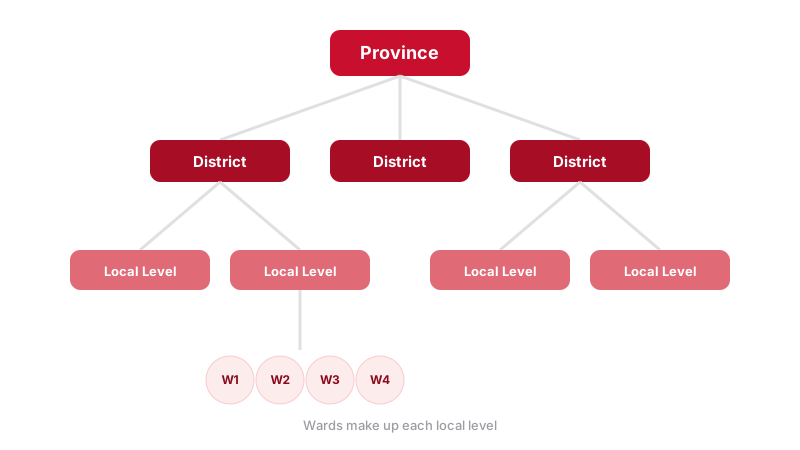
This is the core of the app: the full Province → District → Local Level → Ward hierarchy, searchable in English or Nepali. Each entry includes population, area and density figures where available, and everything renders from a local database rather than a live API call.
Compare provinces
Pick any two provinces and see population, area, density and district count side by side. It's a small feature, but it answers a question people actually ask ("is Bagmati bigger than Koshi?") faster than searching for two separate Wikipedia pages and doing the math yourself.
Daily rashifal
Daily, weekly, monthly and yearly horoscope readings for all twelve signs, in Nepali. This is one of the two features that needs a live connection, since the readings update every day. See the full rashifal guide for how this tradition actually works and why it's such a habitual daily check for so many people.
Live NPR exchange rates
Nepal Rastra Bank's daily buy and sell rates for major currencies, with a built-in NPR-to-foreign-currency converter. Also needs a connection, for the same reason as rashifal: the numbers change daily and there's no point bundling stale rates.
National anthem player
Full lyrics for "Sayaun Thunga Phulka" alongside background audio playback, meaning it keeps playing if you switch to another app or lock your phone. This is one of the few offline features that also needs a specific Android permission to work properly in the background, which we've written about separately if you're curious about the technical side.
Know Your Nepal quiz
A shuffled trivia game pulling from the same bundled dataset, capitals, populations, areas, that sort of thing. Each attempt reshuffles the questions, and you can share your result as a card.
What works offline and what doesn't
This trips people up, so it's worth being precise. The app ships with a bundled SQLite database at install time, so the map, the full province/district/local level explorer, the comparison tool, the quiz and the national anthem all work the moment you open it, with zero signal. Two features specifically need a connection because their data changes daily: rashifal and exchange rates. Everything else is designed to work exactly the same on a plane in airplane mode as it does at home on Wi-Fi.
Is it an official government app?
No, and it's worth being direct about this. Nagarik Nepal is an independent project. It organizes publicly available administrative data into an offline-friendly format, but it isn't operated by, endorsed by, or affiliated with the Government of Nepal in any way. If you're looking for official government services, this isn't that. If you're looking for a fast, offline reference to Nepal's administrative structure and a few cultural extras, that's exactly what this is.
Privacy and permissions
There's no account system and no login. A handful of preferences, favorites, language, theme, are stored locally on your device only. The app uses Firebase Analytics and Crashlytics to catch bugs and understand usage at a basic level, and Supabase for the public reference data itself. None of it involves ads, and none of it is sold to anyone. The full breakdown is in the privacy policy, which is worth a skim if you care about exactly what "analytics" means in practice.
Nagarik Nepal is free, works offline, and takes about a minute to set up.
Join the WaitlistHow to get it
The app is currently in closed testing ahead of its Play Store launch, so it isn't publicly searchable on the Store yet. Use the "Join the Waitlist" button above to get added as a tester or notified the moment it's live. It's a free, Android-only release; there's no iOS version. Once installed, the initial database download happens automatically and the app is usable within a few seconds, since most of the reference content is bundled rather than streamed.
Common questions
Does it drain the battery?
No. The only feature that keeps a background process alive is the national anthem player, and only while it's actively playing. Everything else is a normal, dormant app when you're not using it.
Do I need to create an account?
No. There's no sign-up, no login, and nothing tied to your identity.
Is there a Nepali-language version?
The app itself is fully bilingual with a one-tap toggle between English and Nepali, including proper Devanagari script rendering. This particular guide is in English, but the app's interface isn't.
For the deeper background on the specific numbers this app is built around, the provinces guide and Nepal fact file are good next reads.