

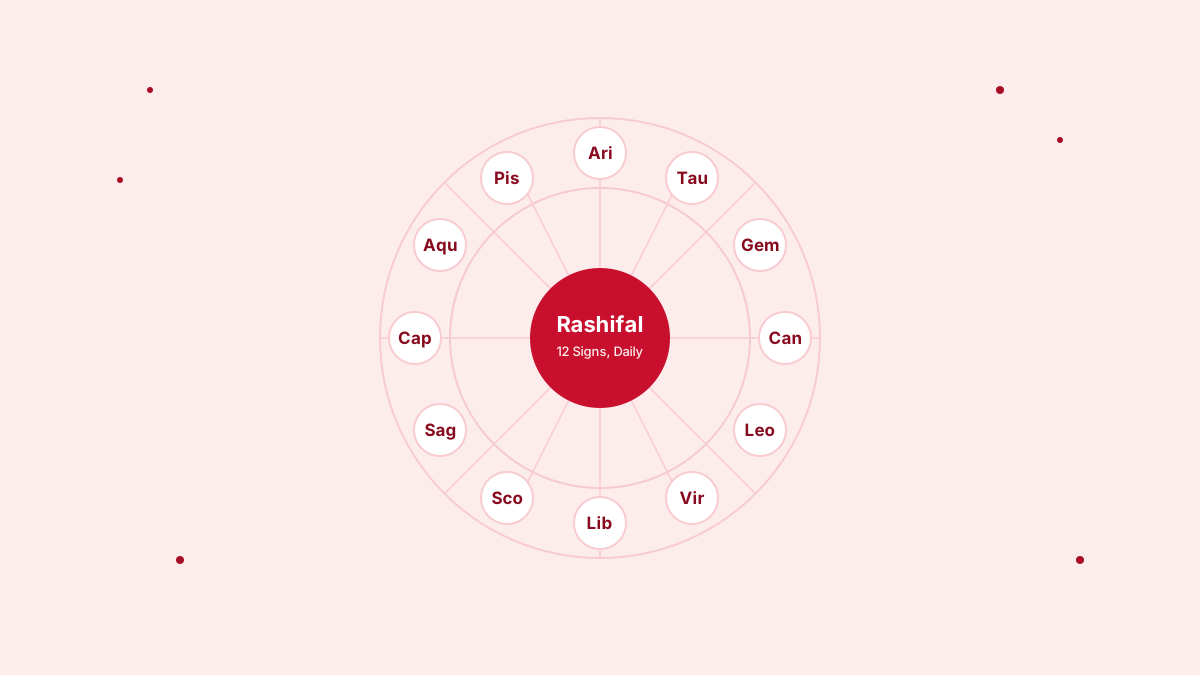
Open almost any Nepali news app, radio bulletin or newspaper's back page and you'll find the rashifal: a short daily reading for each of the twelve rashi, or zodiac signs. It's one of the most consistently checked pieces of content in Nepali media, and it works a little differently from the horoscope column you might be used to elsewhere.
What rashifal actually means
"Rashifal" combines two Sanskrit-derived words: rashi (zodiac sign) and phal (result, or fruit). Put together, it roughly means "the result of one's sign," and that's a fair description of what the daily reading is meant to offer: a short prediction of how the day might unfold for each sign, covering the usual categories of health, career, relationships and finance. It comes out of Vedic astrology (Jyotish Shastra), a tradition with roots stretching back over two thousand years across the Indian subcontinent and still very much a living practice in Nepal today.
The twelve rashis
The twelve signs map fairly directly onto the Western zodiac, since both trace back to the same underlying set of constellations, but they carry Sanskrit names in Nepali usage:
- Mesh (Aries)
- Brish or Vrishabha (Taurus)
- Mithun (Gemini)
- Karkat (Cancer)
- Singha (Leo)
- Kanya (Virgo)
- Tula (Libra)
- Brishchik or Vrishchik (Scorpio)
- Dhanu (Sagittarius)
- Makar (Capricorn)
- Kumbha (Aquarius)
- Meen (Pisces)
Moon sign versus sun sign
Here's the part that actually differs from the horoscope column most Western readers grew up with. Western newspaper astrology is almost always based on your sun sign, the zodiac constellation the sun was passing through on your birth date. Vedic astrology, the system rashifal is drawn from, more commonly determines your rashi from your Chandra Rashi, or moon sign: the constellation the moon occupied at the exact time of your birth. Because the moon moves through the zodiac far faster than the sun, roughly one sign every two to two and a half days rather than one sign per month, two people born on the same date can end up with completely different rashis depending on their birth time. It's also why some readers check both their moon-sign rashifal and a Western sun-sign horoscope out of habit, without necessarily thinking of them as the same system.
Who actually writes it
Daily rashifal content in Nepali media is typically produced by professional astrologers (jyotishi) who calculate planetary positions for the day and interpret them according to classical Vedic astrological principles, rather than being generated automatically. Established newspapers and calendar publishers often work with a named astrologer whose readings run under a byline, similar to a regular columnist, and different publishers can produce noticeably different readings for the same day and sign, since interpretation is still very much part of the craft. This is part of why you'll sometimes hear people compare notes on whose rashifal they follow, the way you might compare weather forecasters.
Why it's such a daily habit
Part of the answer is straightforwardly cultural: astrology is woven into everyday decision-making in Nepal in a way that goes well beyond entertainment, from choosing an auspicious date for a wedding to timing a business launch. Checking the day's rashifal fits naturally alongside checking the Bikram Sambat date on the Nepali calendar, another daily ritual for a lot of households. It's also just a low-effort, low-stakes read: thirty seconds long, mildly entertaining, and occasionally eerily specific enough to be worth a mention over tea.
Beyond the daily reading
Daily rashifal is the most commonly checked version, but it's usually published alongside weekly, monthly and yearly readings too, each pitched at a different kind of decision. A daily reading covers the here and now; a weekly or monthly one is more often used for planning around bigger events, a wedding date, a property purchase, a job change; and yearly readings, often published around the Nepali New Year in mid-April, tend to get wider attention as a kind of annual overview per sign. The underlying methodology across all four timeframes is the same moon-sign-based system, just projected over a longer window.
Where to check yours
Rashifal content in Nepal is refreshed daily, which means any app or website offering it needs a live connection, it genuinely can't be bundled offline the way a static fact like a province's population can. The Nagarik Nepal app includes daily, weekly, monthly and yearly rashifal readings for all twelve signs, alongside a much larger set of offline reference data covering the country's provinces and districts. It's one of exactly two features in the app that needs signal to work, the other being exchange rates, for the same reason: the numbers change every day.
Check today's rashifal for all twelve signs in the Nagarik Nepal app.
Join the WaitlistIf you want to go deeper on the underlying astrological system, Wikipedia's Hindu astrology page is a reasonable starting point, covering both the historical roots and the moon-sign methodology in more depth than fits here.