

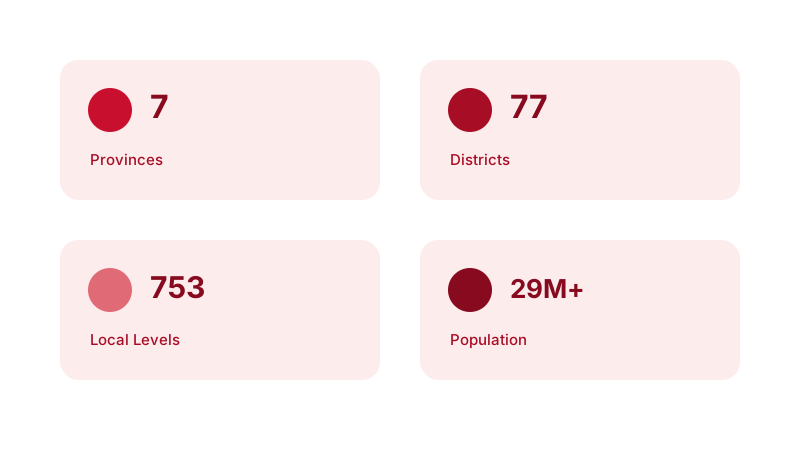
Sometimes you just want the numbers without the narrative. Here's Nepal in one page: geography, population, administrative structure, and a handful of facts that come up constantly in trivia, research and casual conversation alike.
The basics
| Official name | Federal Democratic Republic of Nepal |
|---|---|
| Capital | Kathmandu |
| Government | Federal parliamentary republic |
| Population | Over 29 million (2021 census) |
| Area | Approximately 147,516 km² |
| Currency | Nepali Rupee (NPR) |
| Time zone | Nepal Time, UTC+5:45 |
| Calling code | +977 |
That time zone is worth pausing on: Nepal is one of a handful of countries in the world with a 45-minute offset rather than a round hour or half-hour, which regularly trips up international meeting scheduling and flight connection calculators alike.
Geography
Nepal is landlocked, bordered by China to the north and India on the other three sides. It spans three broad ecological belts running east to west: the flat Tarai plains in the south, the mid-hill region in the middle, and the high Himalayas in the north, home to eight of the world's fourteen peaks over 8,000 metres, including the highest point on Earth. Mount Everest, known in Nepali as Sagarmatha, stands at an officially surveyed height of 8,849 metres, a figure jointly confirmed by Nepal and China in 2020 after a fresh survey.
Administrative structure
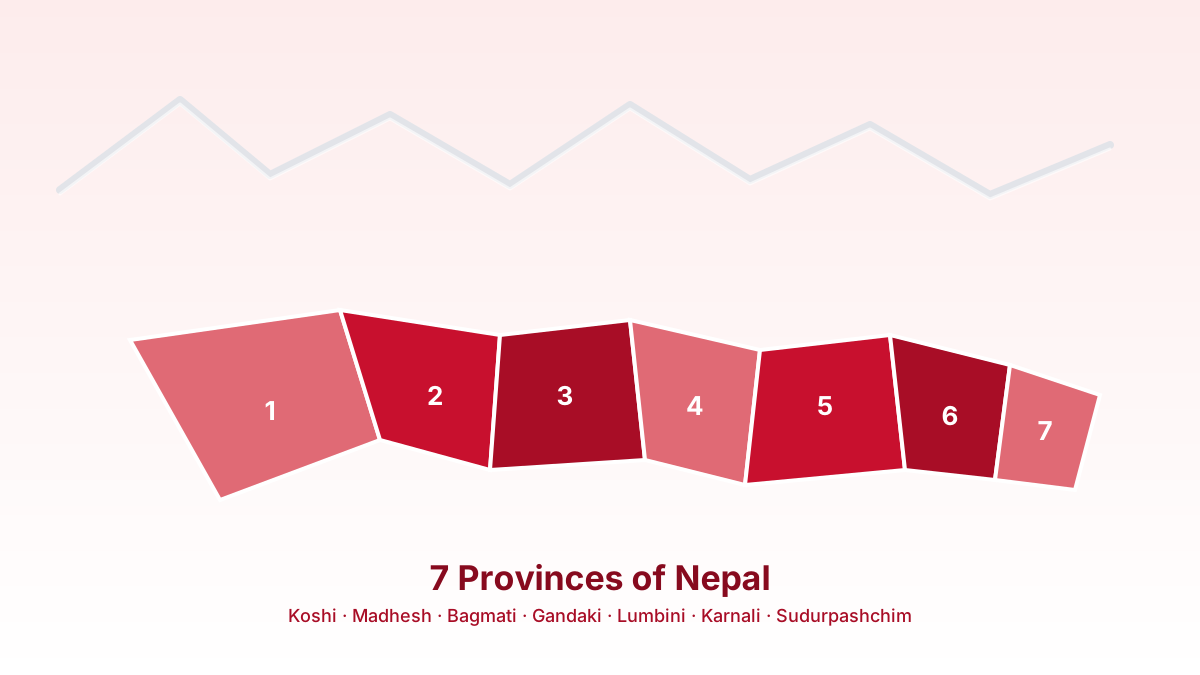
Since the 2015 constitution, Nepal operates as a three-tier federal system:
- 7 provinces: Koshi, Madhesh, Bagmati, Gandaki, Lumbini, Karnali and Sudurpashchim.
- 77 districts: the complete list, organized by province.
- 753 local levels: metropolitan cities, sub-metropolitan cities, municipalities and rural municipalities, further divided into wards.
If you need to look any of this up interactively rather than reading through tables, that's exactly what the Nagarik Nepal app is for, fully offline.
Language, religion and culture
Nepali is the official language and the most widely spoken, written in the Devanagari script, but Nepal is home to well over a hundred recorded languages across its different ethnic communities, several of which hold official recognition at the provincial level. Religiously, Nepal is a secular state today, though the majority of the population identifies as Hindu, with a substantial Buddhist population, particularly across the Himalayan and hill regions, and smaller Muslim, Kirat, Christian and other communities. The country's national symbols and its national anthem both lean into this plurality directly rather than around it, explicitly naming diversity as a source of national identity.
Economy and tourism
Agriculture remains a major source of livelihood for a large share of Nepal's population, even as the economy has diversified over recent decades. Remittances sent home by Nepali workers abroad, covered in more depth in the exchange rate guide, make up an unusually large share of national GDP compared to most countries, a reflection of how many working-age Nepalis are employed overseas rather than domestically. Tourism is another significant pillar, built heavily around trekking and mountaineering in the Himalayan region, along with cultural and religious tourism to sites like the Kathmandu Valley's temple complexes and Lumbini, the Buddha's birthplace. The tourism sector took a heavy hit from the 2015 earthquake and later the COVID-19 pandemic, with recovery being a recurring policy focus in the years since.
Education and literacy
Nepal's literacy rate has climbed substantially over the past few decades, commonly cited at roughly three-quarters of the population today, up from a much lower base in the mid-20th century, though a persistent gap remains between urban and rural areas and between generations, with younger Nepalis showing notably higher literacy than older ones. The education system follows a structure of basic education through grade 8, followed by secondary education, with a national School Leaving Certificate style examination historically marking the transition out of school. Higher education is anchored by public institutions like Tribhuvan University, the country's oldest and largest university, alongside a growing number of private colleges and universities established over the past two decades.
Explore every province, district and local level of Nepal offline.
Join the WaitlistA short history note
Nepal was never colonized, a fact Nepalis will point out fairly readily and with good reason, given how rare that is in South Asia. The modern state traces back to the unification campaign led by Prithvi Narayan Shah in the 18th century, which brought together numerous smaller principalities into a single kingdom. Nepal remained a Hindu monarchy for most of its subsequent history until a decade-long political transition, spanning a Maoist insurgency, mass protests and constitutional negotiation, ended in the monarchy's abolition in 2008 and a new federal constitution in 2015, the same restructuring that produced the provinces, districts and local levels covered throughout this site.
For deeper, sourced detail on any of these figures, Wikipedia's Nepal overview page is thorough and well maintained, and a good jumping-off point for further reading.