

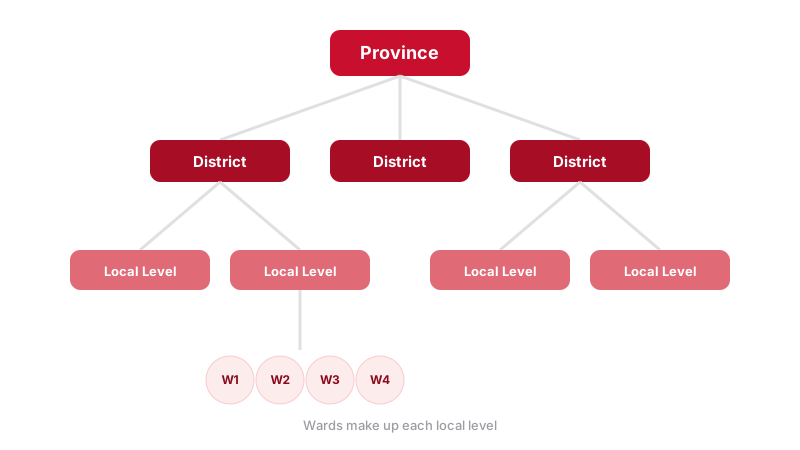
Ask most Nepalis what governs their day-to-day life, road maintenance, birth registration, local taxes, and the honest answer isn't the province and it isn't the district. It's the local level: the municipality or rural municipality they actually live inside. Nepal has 753 of these, and the number is one of the more genuinely useful things to understand about how the country runs, especially if the 2015 federal restructuring happened after you last studied Nepali civics in school.
The four types of local level
All 753 local levels fall into one of four categories, ranked roughly by population size and urban infrastructure:
- Metropolitan City (Mahanagarpalika), 6 in total: Kathmandu, Pokhara, Lalitpur, Biratnagar, Birgunj and Bharatpur. These are Nepal's largest, most urbanized cities.
- Sub-Metropolitan City (Upa-Mahanagarpalika), 11 in total: mid-sized cities that have grown enough population and infrastructure to be upgraded from ordinary municipalities, including places like Dharan, Hetauda and Butwal.
- Municipality (Nagarpalika), 276 in total: smaller urban and semi-urban centers, essentially anywhere with a reasonably developed town core.
- Rural Municipality (Gaunpalika), 460 in total: predominantly rural areas, often covering a larger geographic area with a smaller, more dispersed population.
Add those up, 6 + 11 + 276 + 460, and you get 753. The classification isn't just ceremonial: it affects the budget formula each local level receives from the federal government, and the kinds of infrastructure obligations it's expected to handle.
Why 753, and what came before it
Before the 2015 restructuring, Nepal was divided into thousands of Village Development Committees (VDCs) and municipalities, over 3,900 VDCs alone at one point, each quite small and often under-resourced. The federal reorganization merged these into the current 753 local levels specifically to consolidate budgets and administrative capacity into units large enough to actually deliver services. It's one of the more dramatic pieces of the 2015 transition, and one that reshaped ward boundaries almost everywhere in the country, which is part of why old maps and gazetteers can be misleading today.
Wards: the layer underneath
Each of the 753 local levels is itself divided into wards, the smallest unit of elected local government in Nepal. A ward typically elects a ward chairperson and a small committee, and the number of wards per local level varies quite a bit, generally somewhere between 9 and 33 depending on the local level's population and the number of VDCs or municipalities merged into it during the restructuring. If you've ever seen an address in Nepal written with a ward number, that's this layer.
What a local level actually controls
Under Nepal's federal structure, local levels have constitutionally defined authority over things like local roads, primary healthcare facilities, basic education administration, agriculture extension services, birth and death registration, and local revenue collection such as property tax. Provinces handle a separate, broader set of responsibilities, and the federal government retains national-level matters like defense, foreign policy and currency. In practice, the local level is the government office most people interact with directly and most often.
How local levels get funded
Local levels don't fund themselves entirely from local revenue. Most of their budget comes through a fiscal transfer system from the federal government, split across a few channels: a fiscal equalization grant meant to level out disparities between wealthier and poorer local levels, conditional grants tied to specific programs like education or health, and a smaller share of locally collected revenue such as property tax, business registration fees and local service charges. Metropolitan and sub-metropolitan cities typically raise a larger share of their own budget locally, simply because they have a bigger tax base, while many rural municipalities depend much more heavily on federal transfers to fund basic services. This funding gap is a big part of why the metropolitan versus rural municipality distinction matters administratively and isn't just a naming convention.
Local elections and representation
Each local level elects its own leadership directly: a mayor and deputy mayor for municipalities and metropolitan or sub-metropolitan cities, or a chairperson and vice-chairperson for rural municipalities, alongside ward-level representatives elected separately for each ward within that local level. Nepal has held local elections under this system multiple times since 2017, when the first local elections in two decades were finally held following the long delay caused by the Maoist insurgency and subsequent political transition. These are genuinely competitive, multi-party elections, and local election results are often watched closely as an indicator of national political mood between the less frequent provincial and federal elections.
Quick answers: how many of each type?
The four local-level types go by different names depending on whether you're reading English or Nepali sources, so here are the exact counts against both:
How many nagarpalika (municipalities) are there in Nepal?
276. Nagarpalika is the Nepali term for Municipality, the third of the four local-level types by size.
How many mahanagarpalika (metropolitan cities) are there in Nepal?
6: Kathmandu, Pokhara, Lalitpur, Biratnagar, Birgunj and Bharatpur. Mahanagarpalika is the Nepali term for Metropolitan City.
How many upa-mahanagarpalika (sub-metropolitan cities) are there in Nepal?
11. Upa-Mahanagarpalika is the Nepali term for Sub-Metropolitan City, the tier between metropolitan cities and ordinary municipalities.
How many gaunpalika (rural municipalities) are there in Nepal?
460, the largest of the four categories. Gaunpalika is the Nepali term for Rural Municipality.
How many local levels are there in Nepal in total?
753: 6 metropolitan cities, 11 sub-metropolitan cities, 276 municipalities and 460 rural municipalities.
How many wards are there in Nepal in total?
6,743, spread across all 753 local levels. Individual local levels typically have somewhere between 9 and 33 wards each, depending on population and how many old VDCs or municipalities were merged into them in 2015.
Looking up your own local level
If you know your ward but aren't sure which local level, district or province it belongs to (or you're trying to help a relative abroad fill out a form correctly), that's the exact lookup the Nagarik Nepal app is built for. It resolves the full chain offline, in English or Nepali, without needing to dig through a government gazette PDF. The districts guide and provinces guide cover the two tiers above local levels if you want the complete picture.
For the full, browsable list, every one of the 753 local levels, grouped by district and province, with type, ward count and area, is in the Nepal local levels directory.
Look up any local level or ward in Nepal, fully offline.
Join the WaitlistFor the underlying legal framework, Nepal's Ministry of Federal Affairs and General Administration maintains the official local level classifications, and Wikipedia's Local level (Nepal) page summarizes it well if you want a citable secondary source.