

This did not start as a fight about an app. In the last week of August 2025, Nepalis started comparing two kinds of photos on TikTok and Instagram: coffins of migrant workers coming home from the Gulf next to the vacation and shopping photos posted by the sons and daughters of government ministers. The trend got a name, "Nepo Kids," and by early September it had turned corruption from an abstract complaint into a face people could point at. Days later, the government banned the platforms carrying that trend. Days after that, tens of thousands of people walked toward Maitighar Mandala in Kathmandu, most of them teenagers and people in their twenties, and by the following evening parliament was on fire, the prime minister had fled the capital, and the country was looking for someone, anyone, to run the government. Eighteen months on, that search had gone from a chat app poll organized by strangers on Discord to a national election with a former rapper as the winner.
This is a timeline of how that happened, built from the news organizations, court filings and official statements that covered it as it unfolded. Every figure and quote below is sourced; the full list is at the bottom of the page.
The Nepo Kids who lit the fuse
Nepal's population has a median age of about 25. Roughly 48% of the country uses social media, one of the highest rates in South Asia, and youth unemployment sat at 20.8%. Remittances sent home by Nepalis working abroad made up close to a third of GDP, a statistic that says something on its own about how many young people had already concluded the country had no room for them. An average Nepali citizen earned around $1,400 a year. Against that backdrop, in the last days of August 2025, people started posting a very specific kind of comparison: photos of the coffins of migrant workers arriving home from Gulf countries, next to photos the children of Nepal's political and business elite were posting of themselves abroad.
The trend got a name, "Nepo Kids," and it had specific faces attached to it almost immediately. The image that spread furthest showed Saugat Thapa, son of politician Bindu Kumar Thapa, standing in front of a "Christmas tree" built entirely out of more than 30 luxury gift boxes from Cartier, Louis Vuitton and Gucci; that single photo racked up somewhere between 5 and 10 million views. Alongside it came a montage of his girlfriend, Ashma Kumari KC, Miss Nepal 2024, showing designer outfits and trips across Europe, and posts pointing at Shrinkhala Khatiwada, a former Miss Nepal and the daughter of ex-health minister Gyanendra Bahadur Karki, over her cars and stays abroad. Meme accounts started pairing these images directly against photos of migrant workers' caskets and captions like "nepo babies build Christmas trees with stolen taxpayer money." None of this was subtle, and it wasn't meant to be. Corruption in Nepal had always been assumed. For the first time, it had faces and brand names attached to it, and a stack of migrant workers' coffins to hold up right next to them.
Then came the ban
On September 4, 2025, Nepal's government ordered internet providers to block 26 platforms, including Facebook, X, YouTube, LinkedIn, Reddit, Signal and Snapchat, for failing to register with the Ministry of Communication and Information Technology within a seven-day window that had opened on August 28. Officials pointed to a real legal basis for it, the Directive on the Management of Social Media 2080 and a Supreme Court order requiring platforms to register before operating in the country, and Minister Prithvi Subba Gurung said the companies had "ignored even repeated reminders and extensions."
Almost nobody outside government offices read it as a paperwork story. The Nepo Kids trend had been building for exactly the week before the ban and was still gathering momentum when the block went into effect, and to a public that had just spent seven days watching officials' children get called out by name, a sudden platform shutdown looked less like tax enforcement and more like an attempt to shut off the exposure before it went any further. CNN put the timing plainly in its own reporting: the ban landed close enough on the heels of the Nepo Kids trend that "many" Nepalis came to see it as an effort to suppress criticism of corruption and elite privilege, whatever the government's stated legal justification. The ban didn't manage to quiet anything. If anything, it backfired: people who wanted to keep posting simply moved to VPNs and to platforms that hadn't been blocked, and the anger that had been building online for a week now had somewhere to go that wasn't a screen.
September 8: tear gas at Maitighar and Baneshwor
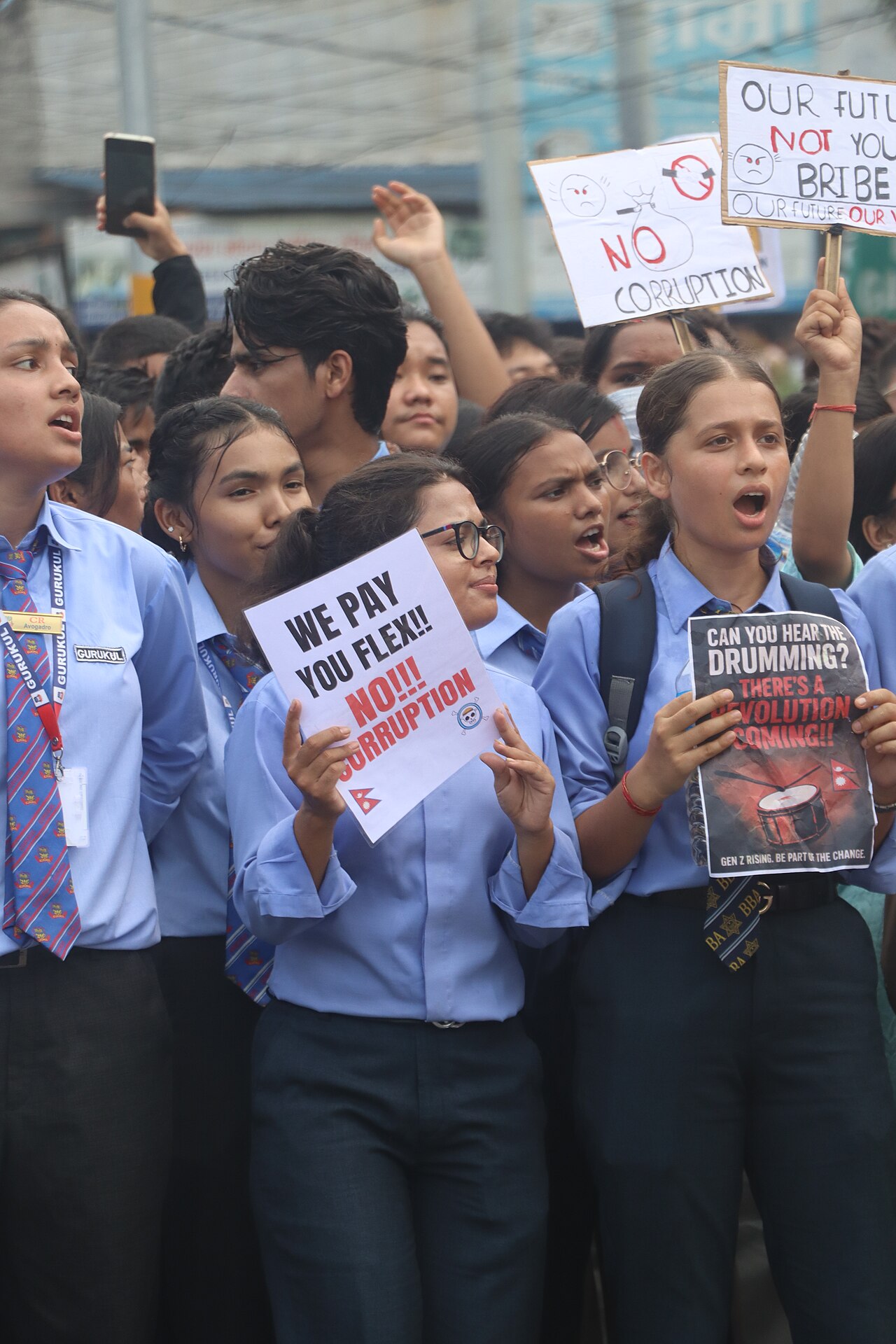
The night before, Kathmandu mayor Balendra "Balen" Shah, an elected independent old enough to be outside the demographic organizing the rally, posted his backing anyway: "Tomorrow, in this spontaneous rally, no party, leader, worker, lawmaker, or activist will use it for their own interest. I will not attend due to the age limit, but it is important to understand their message. I give my full support." He added that the march was "clearly a spontaneous movement of Gen-Z, for whom even I may seem old," and that he wanted to understand their "aspirations, objectives and thinking." It was a small statement at the time. It would matter a great deal more six months later.
The youth organization Hami Nepal, run by civic activist Sudan Gurung, had called for a peaceful rally at Maitighar Mandala, a roundabout a short walk from the parliament building. The crowd that showed up was much larger than a typical protest in Kathmandu, and it kept growing as it moved toward the parliament complex in New Baneshwor. Police responded with tear gas and water cannon, then rubber bullets, and in some locations, live ammunition. By the end of the day, at least 19 people were dead and more than 340 injured; one count put 17 of those deaths in the Baneshwor area alone, near the parliament building itself.
The government lifted the social media ban that same evening. It didn't slow anything down. Home Minister Ramesh Lekhak resigned and had his passport seized. Curfews went into effect in Kathmandu and several other cities. None of it undid what had already happened that afternoon, and none of it stopped what came the next day.
September 9: the day the state burned
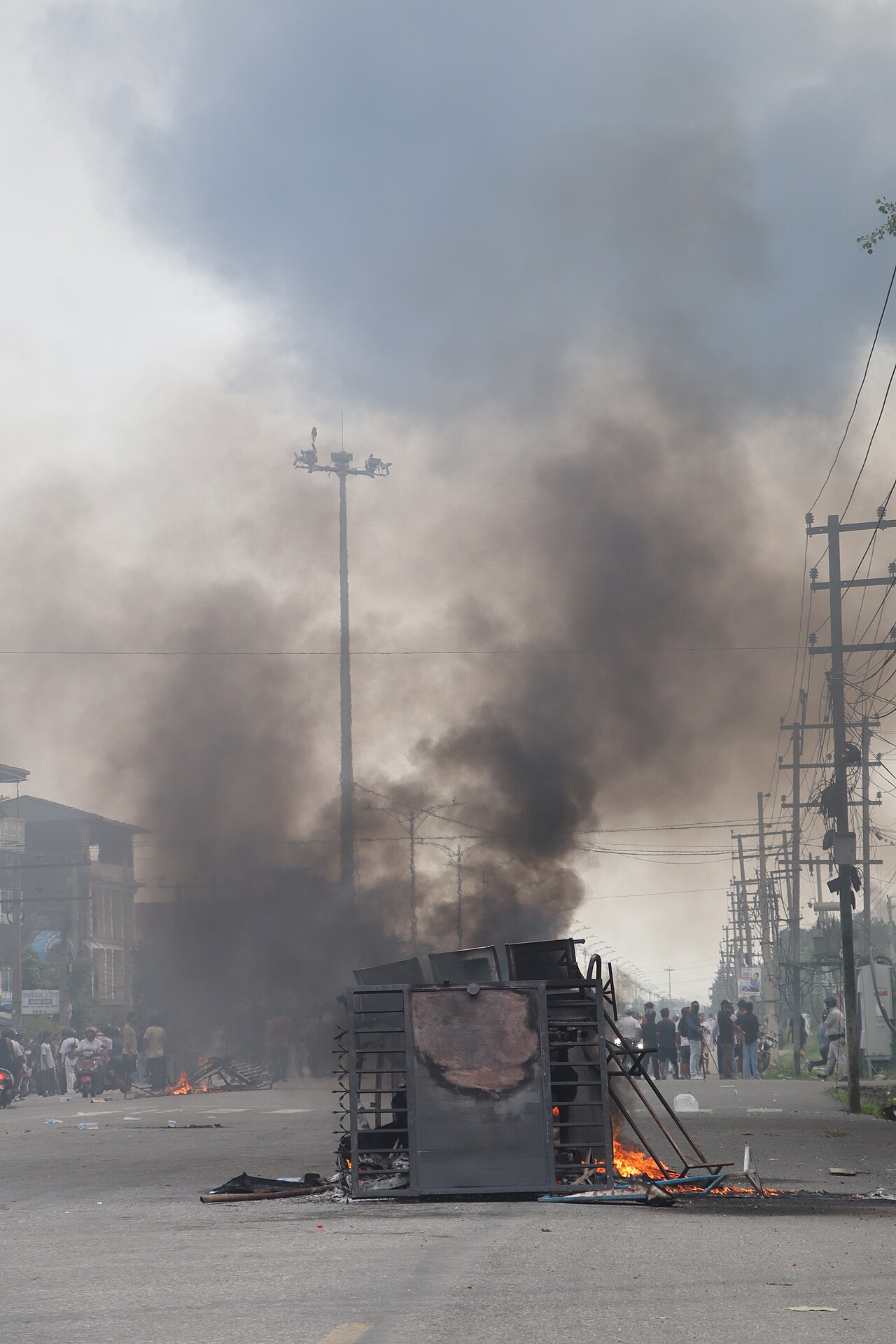
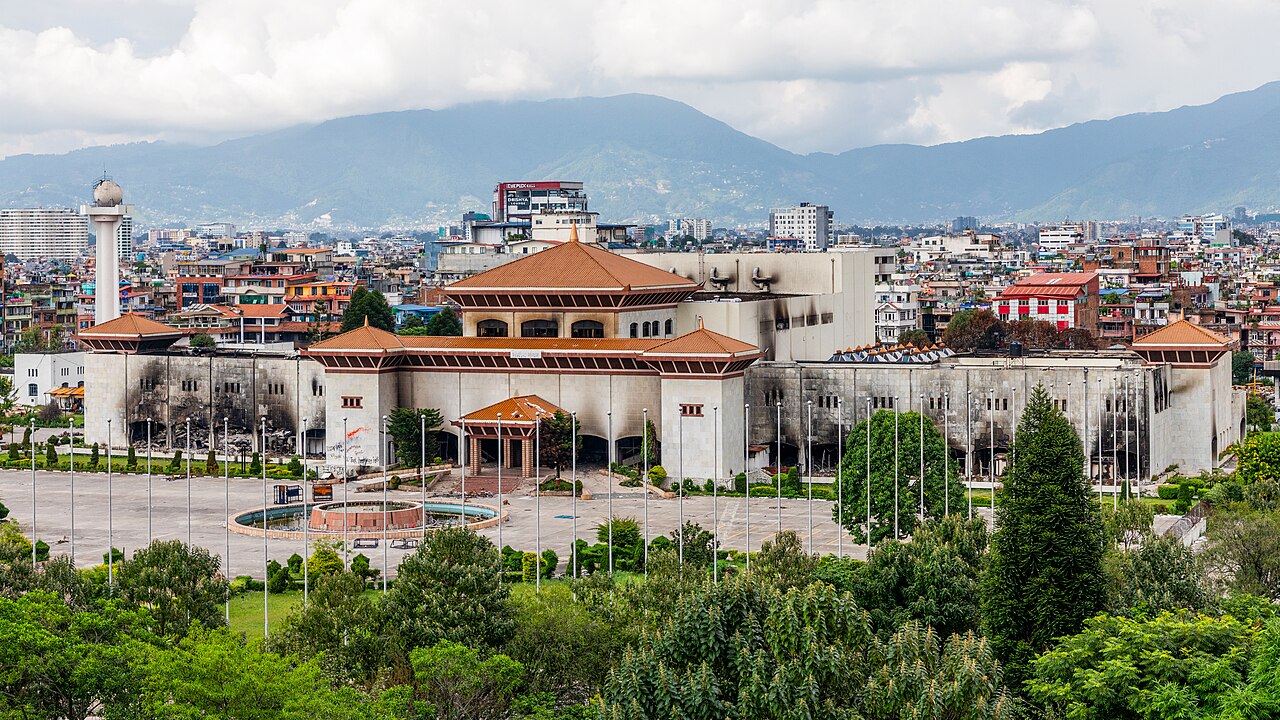
Prime Minister K.P. Sharma Oli resigned on September 9 and, according to multiple reports, was flown by helicopter to an army barracks for his own safety. Over the course of the day, protesters set fire to a remarkable list of buildings: Singha Durbar, the country's central administrative complex; the Federal Parliament building (officially the International Convention Centre, widely known as Sansad Bhavan); a building next to the Supreme Court; Sital Niwas, the presidential residence; Baluwatar, the prime minister's official residence; and the headquarters of both the CPN (UML) and Nepali Congress parties. The Karnali Provincial Assembly, the Ministry of Health and Population building, and a string of district offices and courts around the country were damaged or destroyed the same day.
The violence wasn't limited to buildings. Former prime minister Sher Bahadur Deuba and his wife, then-Foreign Minister Arzu Rana Deuba, were seriously injured when their home was attacked. Former prime minister Pushpa Kamal Dahal (Prachanda) had his residence in Chitwan burned. Former president Bidya Devi Bhandari's house was attacked, and former prime minister Jhala Nath Khanal's wife was critically injured. Prisons were stormed as well: Nakhu Jail in Kathmandu was broken into, freeing former home minister Rabi Lamichhane, who had been serving time on a fraud conviction; a prison in Kaski district reported 773 escaped inmates. Tribhuvan International Airport briefly shut down and was occupied by the army, Kantipur's media headquarters was set on fire, and three police officers were killed in Koteshwor. Army chief General Ashok Raj Sigdel went on record appealing for talks and effectively signaled that the military, not the outgoing government, would be the one keeping order until a new one existed.
Democracy by Discord
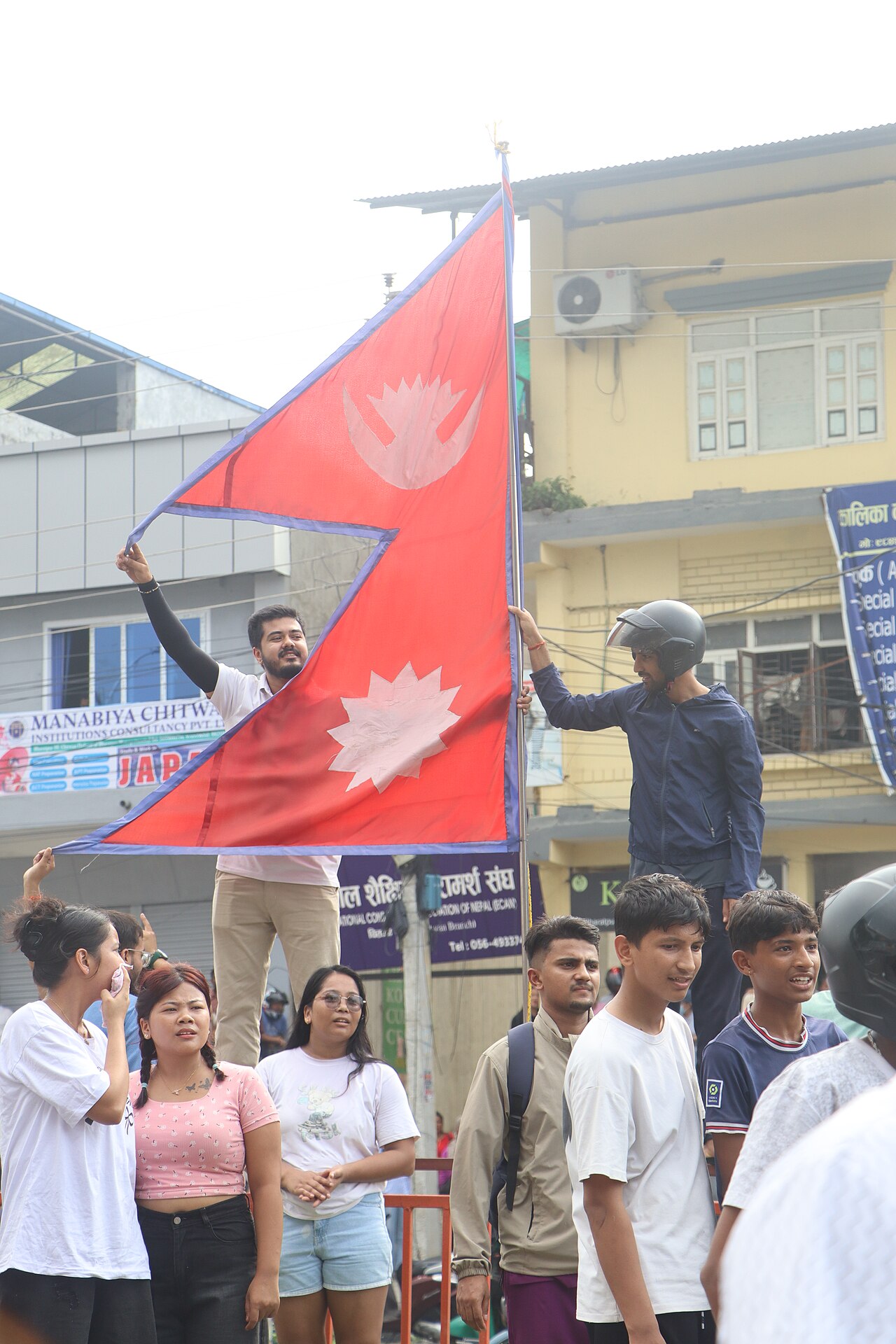
With no prime minister and no functioning cabinet, the immediate question became who would run the country next, and there was no obvious constitutional answer for a leadership vacuum created this fast. Gurung opened a Discord server called "Youths Against Corruption" as an organizing hub; it passed 100,000 members within days and eventually reached around 145,000. Gurung himself became the de facto, unelected point of contact between the protest movement and the army, a role plenty of other protesters openly disputed, arguing he didn't speak for a movement that had never elected anyone to represent it. At one point, defending the threat the streets still posed, he put it bluntly: "If we come back to the streets, no one can stop us. We will rip them out from where we put them."
On September 11, President Ram Chandra Paudel, Army Chief Sigdel and a group of Gen Z representatives sat down together to work out what would happen next; the death toll had reached 34 by that point. Separately, on the Discord server, an online poll asked participants to pick a candidate for interim prime minister. Of 7,713 votes cast, former chief justice Sushila Karki won 3,833, or 49.7%, beating out Kathmandu mayor Balen Shah and energy official Kul Man Ghising. It was an unusual way to select a head of government, run on a platform better known for gaming communities than governance, and it worked well enough that the name it produced is the one the president swore in the next day.
Shah lost that poll and said so without any bitterness in his voice. "I fully support your proposal to lead this interim/electoral government by former Chief Justice Sushila Karki," he wrote. "I would like to sincerely respect your understanding, wisdom, and unity. This shows how mature you are." It reads, in hindsight, like the opening line of a much longer campaign. He would spend the next six months building exactly the kind of political standing that turns a gracious loss into a win the next time the country actually voted.
Sushila Karki, first woman to run the country
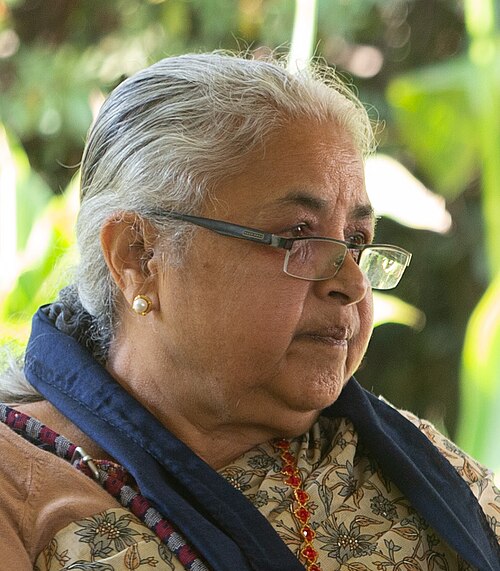
Karki, 73, was sworn in on September 12 as Nepal's first female prime minister, interim or otherwise. President Paudel dissolved parliament the same day and set March 5, 2026, as the date for new elections. Karki was not a career politician. Born in Biratnagar in 1952, she earned a law degree from Tribhuvan University in 1978, worked as a lawyer and law professor, and in 2016 became Nepal's first female Chief Justice of the Supreme Court, a position she held until retiring in 2017. Her record on the bench, particularly a reputation for ruling against powerful, politically connected defendants, was exactly why Gen Z organizers pushed her name in the first place.
She was candid about how odd her own appointment was. "I did not come to this position because I had sought it, but because there were voices from the streets demanding that Sushila Karki should be given the responsibility," she said after taking office. She also set explicit limits on how long she intended to stay: "We will not stay here more than six months in any situation." Her 15-member interim cabinet included Rameshwar Khanal as finance minister, Kul Man Ghising (the Discord poll runner-up) at the energy ministry, engineer and rural connectivity advocate Mahabir Pun at education, and Sudha Sharma Gautam at health. Her government pledged 1 million Nepali rupees, roughly $7,000, to the family of each person killed in the unrest, and set up a High-Level Inquiry Commission to investigate exactly what security forces had done during those two days.
Counting the dead
The death toll shifted almost daily in the weeks after the protests, which is normal for an event this chaotic and this large, but it makes any single number worth treating carefully. Nineteen people were reported dead on September 8 alone; by September 22, most tallies had climbed past 70. The figure that stuck, drawn from the Nepal Army's own accounting, settled at 76 dead in total.
| Category | Deaths |
|---|---|
| Protesters | 22 |
| Police officers | 3 |
| Prisoners shot during jailbreaks | 10 |
| Others (unspecified in the official breakdown) | 41 |
| Total | 76 |
The government's own confirmed injury count, finalized as late as May 2026, stood at 2,113. Among them was Shantanu Dhakal, an 18-year-old shot in the jaw during protests in Itahari, who documented his own recovery on social media over the following months, one of the few faces behind the statistics that the public actually got to follow. UN Secretary-General António Guterres said he was saddened by the loss of life, and the UN's human rights chief, Volker Türk, called for an independent investigation into how security forces had responded. Amnesty International, Human Rights Watch and the International Federation for Human Rights all condemned the crackdown and pressed for accountability. The government that eventually took office six months later did act on that demand, which the section on arrests below covers.
The six-month countdown to a ballot
Karki's government had one real job written into its mandate: hold an election by the date the president had already announced, March 5, 2026, and hand over power. Nepal's Election Commission registered more than 915,000 first-time voters in the run-up to the vote, roughly two-thirds of them under 30. A striking 120 political parties ended up on the ballot in some form, and about two-thirds of sitting MPs from the dissolved parliament chose not to run again, whether out of caution, exhaustion, or a reasonable read on which way the wind was blowing. Turnout on election day came in at roughly 59%.
A rapper becomes prime minister
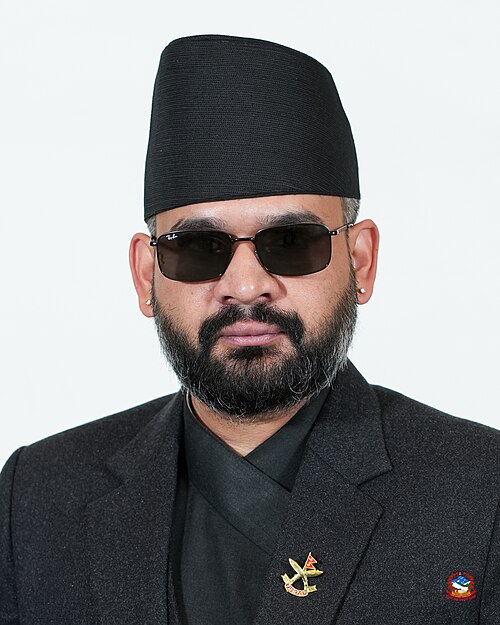
Long before any of this, Balendra Shah was better known under his stage name in Nepal's underground Nephop scene than as a politician. He released his debut single, "Sadak Balak" ("Street Kid"), in 2012, rapping about inequality and life on Kathmandu's streets, and built a following battling other MCs on the YouTube series Raw Barz in 2013, with lyrics that took direct aim at the same political class he would later run against. Off stage, he was training as a civil engineer, and went on to earn a master's degree in structural engineering from NITTE in Bengaluru, India, in 2018. He came home, worked as a structural engineer on Kathmandu Valley infrastructure projects, and started doctoral research at Kathmandu University on conserving traditional Newar architecture, an unlikely combination of resume lines for a future prime minister.
In May 2022, running as an independent with no party machine behind him, Shah won the Kathmandu mayoral race outright, 61,767 votes, 38.6% of the total, beating candidates fielded by both of Nepal's dominant establishment parties. As mayor he governed the way he had rapped, loudly and online, posting directly to constituents, pushing through infrastructure and waste management projects, and handing out scholarships. He also picked fights that made him plenty of enemies: bulldozing illegal construction along riverbanks and roads and displacing street vendors who had operated for years, moves that supporters called overdue enforcement and critics called heavy-handed. He turned down repeated offers to join an established party during those years and stayed formally independent straight through the September 2025 protests, when his name went into the Discord poll and lost to Karki's.
He waited three and a half months after that loss before changing course. On December 28, 2025, Shah joined the Rastriya Swatantra Party (RSP) as its prime ministerial candidate, a party with its own strange thread running back into this story: it had been founded in 2022 by Rabi Lamichhane, the same former home minister who had walked free from Nakhu Jail during the September riots. Shah resigned as Kathmandu's mayor on January 18, 2026, to run for parliament, and rather than defend safe ground in his own city, he chose to contest Jhapa-5, the eastern constituency K.P. Sharma Oli had represented for years. When the votes came in on March 5, RSP had won a landslide nationally, 182 of 275 seats and 47.84% of the proportional vote, the highest share recorded since Nepal adopted its current electoral system in 2008, and Shah had beaten Oli personally in his own seat, 68,348 votes to 18,734, a margin of nearly 50,000.
| Party | Seats (of 275) | Result |
|---|---|---|
| Rastriya Swatantra Party (RSP) | 182 | Landslide majority, first single-party majority since 1999 |
| Nepali Congress | 38 | Worst result in party history |
| CPN (UML) | 25 | Worst result in party history |
| CPN (Maoist Centre) | 17 |
Shah was sworn in as prime minister on March 27, 2026, at age 35, the youngest person to hold the office in Nepal's history.
What the new government has done since
One of the new administration's first moves was to act on the Karki-era Inquiry Commission's findings. On March 28, 2026, K.P. Sharma Oli was arrested at his residence in Bhaktapur, and former home minister Ramesh Lekhak was arrested separately in Kathmandu. The commission had concluded that both men bore responsibility for failing to stop security forces from firing on demonstrators, and that their public claims of not knowing what was happening amounted to criminal negligence. Both were remanded into judicial custody, and Nepal's Supreme Court upheld and extended their detention through the following days. The Shah government also promised jobs at the Nepal Electricity Authority, the utility Kul Man Ghising had run before and during his time in Karki's cabinet, for family members of those killed in the protests.
Plenty remains unresolved. As of March 2026, there was still no concrete plan to rebuild the burned parliament building, six months after the fire. Whether the prosecutions of Oli and Lekhak hold up under Nepal's court system is still an open question, and RSP now has to govern with a parliament where, by design, most of the sitting members have never held office before. A protest movement organized almost entirely through phones and chat apps got exactly what it was demanding: a resignation, an interim government, an election, arrests. What it does with a two-thirds majority is a different kind of test, and one that a Discord poll can't settle in advance.
Frequently asked questions
Why did Nepal's Gen Z protest in September 2025?
The immediate trigger was a September 4, 2025 government order blocking 26 social media platforms, but the deeper cause was corruption. A viral "Nepo Kids" trend earlier that week had exposed the lavish lifestyles of politicians' children, and many Nepalis saw the ban as an attempt to shut that exposure down rather than a genuine registration measure.
What was the "Nepo Kids" trend?
In late August 2025, Nepalis on TikTok and Instagram began posting side-by-side comparisons of migrant workers' coffins and the luxury lifestyles of officials' children. The most viral image showed Saugat Thapa, son of politician Bindu Kumar Thapa, posing in front of a "Christmas tree" built from Cartier, Louis Vuitton and Gucci gift boxes.
How many people died in Nepal's Gen Z protests?
The Nepal Army's final count put the toll at 76 dead, including 22 protesters, 3 police officers and 10 prisoners shot during jailbreaks, plus more than 2,100 injured. Early tallies from September 8 alone reported at least 19 deaths.
Who is Sushila Karki?
Sushila Karki is a 73-year-old former Chief Justice of Nepal's Supreme Court (2016 to 2017) who was sworn in as interim prime minister on September 12, 2025, becoming the first woman to lead the country. Gen Z organizers picked her name through an online Discord poll after Prime Minister K.P. Sharma Oli resigned.
How was Nepal's interim prime minister chosen?
Protest organizers ran an informal poll on a Discord server that had grown to roughly 145,000 members. Of 7,713 votes cast, Sushila Karki won 3,833 (49.7%), beating Kathmandu mayor Balen Shah and energy official Kul Man Ghising. President Ram Chandra Paudel swore her in the next day.
Who is Balen Shah?
Balendra "Balen" Shah is a Nepali rapper and structural engineer who served as Kathmandu's independent mayor starting in 2022. He lost the September 2025 Discord poll for interim prime minister, joined the Rastriya Swatantra Party in December 2025, and was elected prime minister in his own right on March 5, 2026, at age 35.
Did Balen Shah's party win Nepal's 2026 election?
Yes. The Rastriya Swatantra Party won 182 of 275 seats and 47.84% of the proportional vote in the March 5, 2026 election, the largest single-party majority since Nepal's current electoral system began in 2008. Shah personally defeated former prime minister K.P. Sharma Oli in the Jhapa-5 constituency.
What happened to K.P. Sharma Oli after he resigned?
Oli stayed out of office through the Karki interim government. On March 28, 2026, the day after Balen Shah's government took power, Oli was arrested at his home in Bhaktapur along with former home minister Ramesh Lekhak, based on an inquiry commission finding of criminal negligence in the deaths of protesters.
A note on sourcing
This account was put together from the news organizations, encyclopedic sources and official statements listed below, not from original reporting on the ground. Casualty and vote figures are attributed to the outlet or institution that reported them because different sources published slightly different numbers in the days after the unrest, and that disagreement is itself part of an honest record of what happened. Photographs carry individual credit and license information in their captions. If you're using this page as a reference and spot something that's since been corrected or updated, the Wikipedia articles linked below are actively maintained and worth checking against.
With new local representatives and a new parliament in place since the March 2026 election, make sure your own voter details and local level are up to date.
Read the voter registration guideReferences and further reading
- 2025 Nepalese Gen Z protests, Wikipedia
- 2025 storming of the Nepalese Parliament, Wikipedia
- Karki interim cabinet, Wikipedia
- 2026 Nepalese general election, Wikipedia
- Balendra Shah, Wikipedia
- Sushila Karki, Wikipedia
- 2025 Nepalese Gen Z Protests: Background, Social Media Ban, and Political Breakdown, Encyclopaedia Britannica
- Background on the #Nepokids Trend and Nepal's Gen Z Protests, DeshGujarat
- Who is Saugat Thapa? Nepal's 'nepo baby' slammed for flaunting luxury life, DNA India
- Nepal's social media ban explained in six questions, The Kathmandu Post
- A social media ban, corruption and 'Nepo Kids': what we know about the deadly protests that ousted Nepal's leader, CNN
- Mayor Balendra Shah backs Gen-Z rally against corruption and social media ban, The Kathmandu Post
- Kathmandu Mayor Balen Shah backs Sushila Karki for Nepal's interim govt, The Tribune
- Who is Sushila Karki, Nepal's new 73-year-old interim prime minister?, Al Jazeera
- How Gen Z-led protests put Nepal's 1st female prime minister in power, NPR
- Nepal crisis: Army deployed as death toll rises amid political turmoil, UN News
- From Streets to Discord: How Nepal's Gen Z Toppled a Government, Carnegie Endowment for International Peace
- A New Generation Takes Power in Nepal, Carnegie Endowment for International Peace
- Nepal's Revolution Wasn't Televised, but It Was on Discord, The Nation
- Who is Sudan Gurung, the man behind massive Gen Z protest in Nepal?, Business Standard
- Who, or what, is Hami Nepal?, Nepali Times
- Nepal's ex-PM detained over alleged role in deadly protest crackdown, Al Jazeera
- No immediate plan to rebuild BICC six months after fire, The Kathmandu Post
- Parliament building photograph by Bijay Chaurasia, CC BY-SA 4.0, via Wikimedia Commons
- Chitwan protest photograph by Himal Suvedi, CC0, via Wikimedia Commons
- Burning barricade photograph by Himal Suvedi, CC BY-SA 4.0, via Wikimedia Commons
- Flag protest photograph by Himal Suvedi, CC BY-SA 4.0, via Wikimedia Commons
- Sushila Karki portrait, US Embassy Kathmandu, public domain
- Balendra Shah official portrait, Government of Nepal, CC0