


If you've seen "Rastriya Parichaya Patra" (राष्ट्रिय परिचयपत्र) mentioned alongside a bank form, a new SIM card, or an e-passport application, that's Nepal's National Identity Card, usually just called the NID. It's the newest document in a Nepali citizen's paper trail, and for a growing list of services, it's becoming the one that actually gets checked first. Here's what it is, what it isn't, and why it exists alongside a citizenship certificate rather than instead of one.
What the National ID actually is
The National Identity Card is a biometric smart card that assigns every enrolled Nepali citizen a single, unique 10-digit National Identification Number (NIN). The program is run by the Department of National ID and Civil Registration (DoNIDCR, formerly branded the National ID Management Center) under the Ministry of Home Affairs. It commenced in fiscal year 2018/19, with an early pilot distributing cards to government employees in Panchthar district before a wider rollout began in Rupandehi with an initial batch of 110,000 cards, and has since extended, district by district, across the country.
What's printed and stored on the card
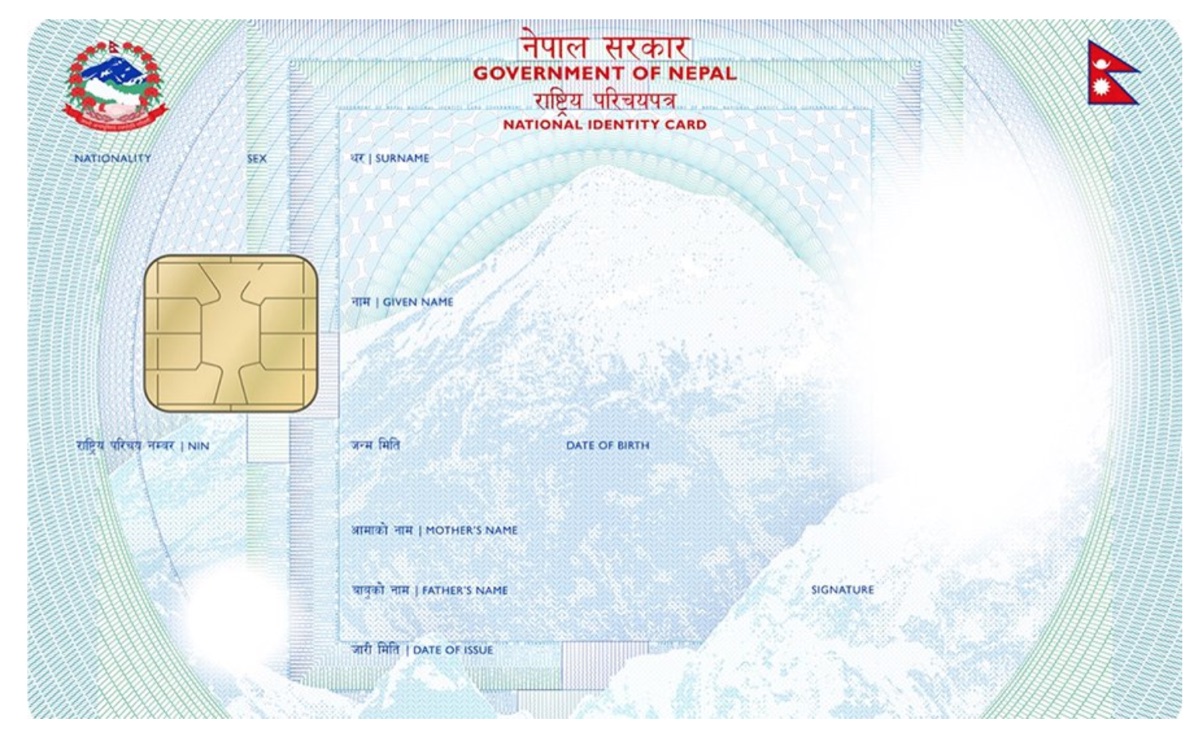
The card itself carries your NIN, full name in Nepali and English, date of birth, sex, nationality, your mother's and father's names, your photo and signature, and a contact smart chip. Behind that chip sits your biometric enrollment data: all ten fingerprints, an iris scan, and your photograph, captured once at enrollment and used afterward to verify that the person presenting the card is actually who the card says they are.
Who issues it, and a rocky rollout
DoNIDCR issues the card, but the vendor behind the card's production has itself been a point of controversy. The original contract to manufacture and personalize the cards went to Advantage International, a local affiliate of the French biometrics firm Idemia, signed in 2018. In 2023, the government canceled that contract and reawarded card production to Schema Technology, a company reported to be owned by figures connected to the then prime minister, a decision that drew criticism over the conflict of interest it implied. That reporting doesn't change what's printed on your card, but it's part of why the rollout has been slower and more contested than a purely administrative ID program would suggest.
NID vs. citizenship certificate: the actual difference
This is the part people get confused about most, and the sequence matters. Your citizenship certificate is the constitutional and legal proof that you're a Nepali citizen, issued under Nepal's citizenship law by your District Administration Office. It doesn't expire, and it's the document everything else, including the National ID, is built on top of. You cannot register for a National ID without already holding a valid citizenship certificate; the certificate is upstream, the NID is downstream.
What the NID adds isn't legal status, it's a machine-verifiable, biometric layer on top of status you already have. A citizenship certificate is a paper document a clerk reads and judges by eye. An NID is a chip a machine can check against a fingerprint or an iris scan in seconds, which is exactly why banks, telecoms and e-government systems have started asking for it specifically, it plugs into digital verification (e-KYC) in a way a decades-old paper certificate simply can't. The stated long-term plan is for the NID to eventually also function as a unified credential covering voter identification and social security, alongside its identity role, but as of 2026 it has not replaced the citizenship certificate itself, and there's no indication that's imminent.
Why it matters now: the mandatory list
Nepal never passed a single sweeping law declaring "you must have an NID." Instead, it's become a practical requirement one service at a time. As of 2026, you'll typically be asked for your NID or NIN to:
- Open a new bank account (mandatory at most banks since a directive took effect in mid-January)
- Apply for an e-passport
- Register or re-register a mobile SIM card
- Register a new company
- Complete certain real estate transactions
- Enroll in social security schemes
None of these individually require a new law each time, they're operational decisions by individual ministries and regulators to lean on the NID as the standard identity check, which is exactly how it's become the practical gateway document even without a single unifying mandate behind it.
The ID for minors: Nabalik Parichaya Patra
Registration for the standard National ID is open to citizens aged 16 and above who already hold a citizenship certificate. Nepal has since added a separate card for children under 16, the Nabalik Parichaya Patra (Minor's Identity Card), introduced under the fourth amendment to the NID rules. It's linked to a parent's NIN rather than issued as a fully independent credential, and in practice a child's NIN can be assigned at birth registration, with the physical adult card following once they turn 16 and enroll in person.
Where the rollout actually stands
The gap between people who've registered and people who actually hold a card in hand is the single most telling number in this program. As of mid-2025, per Department figures reported by the biometrics industry outlet Biometric Update, more than 17.21 million people had completed enrollment and 6.23 million cards had been printed, but only around 2.31 million cards had actually been collected, meaning close to two-thirds of registered applicants hadn't picked theirs up. Tulasi Prasad Dahal, head of the National ID Management program, attributed the gap directly to the requirement that applicants appear in person to collect their card: "still 65.66 percent of the citizens haven't shown any interest to collect their cards being physically present at the concerned places." For citizens in remote districts, that single in-person trip can mean days of travel, which is a large part of why distribution campaigns have kept expanding into new districts, including Kathmandu and Jhapa, through 2025.
The digital NID, and a name mix-up worth avoiding
Once your card is issued, a digital version (eNID) is available through the government's official Nagarik App, the same app used for citizen e-services generally. That's worth flagging clearly: the Government of Nepal's official Nagarik App is not the same product as this site's own Nagarik Nepal app. Nagarik Nepal is an independent offline reference app for provinces, districts and local levels, it does not issue, store or verify your National ID, and it has no connection to DoNIDCR. If you're looking to check your eNID, you want the government's Nagarik App, not this one.
Ready to actually register? Read the step-by-step application guide next.
How to Apply for the National ID CardFrequently asked questions
What is Rastriya Parichaya Patra?
Rastriya Parichaya Patra is the Nepali name for the National Identity Card (NID), a biometric smart card issued by Nepal's Department of National ID and Civil Registration. It carries a unique 10-digit National Identification Number (NIN) along with a photo, fingerprints and a smart chip storing demographic and biometric data.
Does the National ID replace the citizenship certificate?
No. The citizenship certificate remains the legal proof of Nepali citizenship, and you must already have one to register for a National ID. The NID is a separate biometric identity card built on top of your citizenship, not a replacement for it, as of 2026.
Is the National ID card mandatory in Nepal?
It has become mandatory in practice for many services rather than by a single blanket law: opening a bank account, applying for an e-passport, registering a SIM card, company registration and social security schemes all now require it in most cases.
How many Nepalis have received their National ID card?
As of mid-2025, more than 17.21 million people had enrolled and 6.23 million cards had been printed, but only about 2.31 million cards had actually been collected, meaning roughly two-thirds of registered applicants had not picked up their printed card.
For the exact requirements and centers, the Department of National ID and Civil Registration is the authoritative source, this guide is a starting point, not a substitute for confirming your specific case with them. Wikipedia's National Identity Card (Nepal) page is a solid starting point if you need a citable overview of the program's history.