

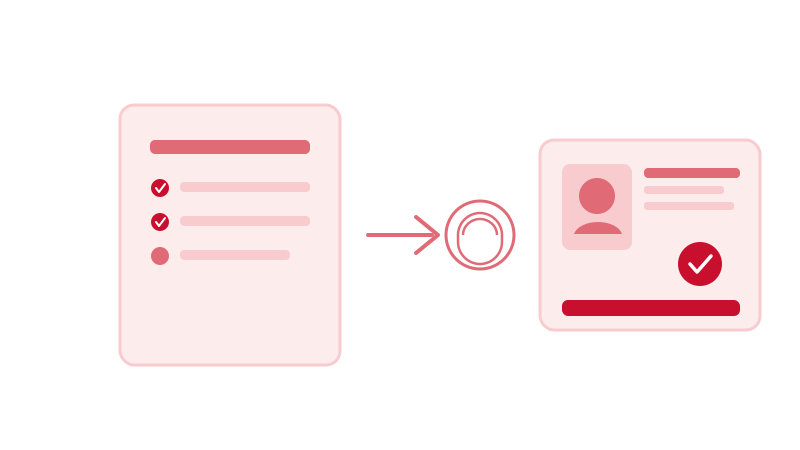
Applying for Nepal's National ID card (Rastriya Parichaya Patra) is a two-step process: an online form first, then an in-person visit second. Neither step is complicated on its own, but skipping preparation before the in-person step is exactly why so many applications stall. If you're new to the process, or want to understand what NID actually is before applying, start with our explainer on what the National ID card is first. This guide is the walkthrough for actually getting one.
Who's eligible
Any Nepali citizen aged 16 or above holding a valid citizenship certificate can register. That citizenship certificate isn't optional paperwork, it's the foundation the entire application is verified against, so if yours is old, damaged, or was issued somewhere you no longer live, sort that out with your District Administration Office before you start the NID process. If you don't have one yet, our citizenship certificate guide covers that first step.
Documents to gather first
Have these ready before you begin, ideally as both originals and photocopies:
- Original citizenship certificate
- Birth certificate
- Proof of your current address
- A recent passport-size photo, forward-facing, on a white background
- Marriage certificate or migration certificate, if either applies to you
- A working mobile number you can receive an OTP on
Step 1: Online pre-enrollment
Go to the official pre-enrollment portal at enrollment.donidcr.gov.np, operated by the Department of National ID and Civil Registration under the Ministry of Home Affairs. Select the individual applicant login (as opposed to the separate service-provider login meant for institutions), enter your mobile number, and verify it with the OTP sent by SMS. From there, fill in your demographic details exactly as they appear on your citizenship certificate, mismatched spelling between documents is one of the most common causes of delay, upload the documents listed above, and choose the enrollment center where you'll complete the next step. Pick a center you can realistically get back to later, since you'll need to return there both to finish enrollment and, eventually, to collect the physical card.
Step 2: Biometric capture in person
With your pre-enrollment submitted, visit your chosen District Administration Office or designated enrollment center in person, bringing the original documents you uploaded online. Staff there capture your photograph, all ten fingerprints, an iris scan, and your signature. This is also your chance to catch and correct any data entry mistakes from the online form before they get baked into a printed card, so review what's on screen carefully before you sign off.
What happens after enrollment
Once biometrics are captured, your application moves into central processing and printing. There's no fixed public turnaround time, cards are produced in batches and rollout has continued expanding district by district rather than running as a single simultaneous national push, so timelines vary a fair amount depending on where you're enrolled and how recently your district ran a distribution campaign.
Collecting your card
This is the step that trips up the most applicants, nationally. As of mid-2025, more than 17.21 million people had completed enrollment and 6.23 million cards had already been printed, but only around 2.31 million had actually been collected. The National ID program doesn't mail cards out, you have to appear in person at your enrollment center to receive it, and for people in remote areas that can mean a multi-day trip. Tulasi Prasad Dahal, who heads the National ID Management program, put the collection shortfall bluntly: 65.66 percent of registered citizens simply hadn't shown up in person to collect their printed cards. If you've enrolled, don't assume your card will find its way to you, plan the return trip as part of the process, not an afterthought.
Checking your application status
You can check where your application stands using the token number you received at pre-enrollment along with your date of birth, on the official status-check page linked from the DoNIDCR portal. It will show whether your application is still processing, has been printed, or is ready for you to collect at your chosen center.
Fixing a mistake in your application
If you spot an error after submission, a misspelled name, wrong date of birth, or similar, contact your chosen enrollment center directly rather than resubmitting the online form from scratch. Correcting details before biometric capture is far simpler than trying to fix a printed card afterward, which is another reason it's worth reviewing your details carefully at the in-person step rather than rushing through it.
Applying for a child under 16
Children under 16 aren't left out of the system, they're covered through a separate credential, the Nabalik Parichaya Patra (Minor's Identity Card), introduced under the fourth amendment to the NID rules. It's linked to a parent's National Identification Number rather than processed as a standalone adult-style application, and in practice a child's own NIN can be assigned at birth registration, with the full biometric enrollment and physical adult card following once they turn 16 and go through the same two-step process described above.
Still deciding whether you need one, or how it differs from your citizenship certificate? Read the full explainer.
What Is Nepal's National ID Card?Frequently asked questions
Who is eligible to apply for Nepal's National ID card?
Any Nepali citizen aged 16 or above who holds a valid citizenship certificate can register. Children under 16 are covered separately through the Nabalik Parichaya Patra (Minor's Identity Card), linked to a parent's National Identification Number.
What documents do I need to apply for the National ID card?
You need your original citizenship certificate, your birth certificate, proof of your current address, a recent passport-size photo with a white background, and, if applicable, your marriage certificate or migration certificate.
Is there a fee to apply for the National ID card?
No. Registration for Nepal's National Identity Card is free.
How do I check my National ID application status?
Use the token number issued at your pre-enrollment along with your date of birth on the official DoNIDCR status-check page to see whether your card is still processing, has been printed, or is ready to collect.
Can I get my National ID card delivered to my home?
No. You must appear in person at your enrollment center to collect the physical card. This in-person requirement is the main reason millions of printed cards remain uncollected nationwide.
For center locations, current campaign schedules, and edge cases this guide doesn't cover, the Department of National ID and Civil Registration is the authoritative source, treat this guide as preparation, not a replacement for their own instructions.